
Neurodivergent Communication Support for ADHD and Autism: How We Work at TalkCoach
If you are considering communication support for yourself, your teenager or your young adult child, you may be wondering whether TalkCoach is the right fit.
You might be autistic, ADHD, AuDHD or otherwise neurodivergent. You might suspect neurodivergence but not have a formal diagnosis. Or you might simply recognise that communication feels harder, more stressful or more effortful than it seems to for other people.
At TalkCoach, we offer both Speech and Language Therapy and Communication Coaching for teenagers and adults.
This blog explains how we support neurodivergent communication, what sessions may involve, and what we do and do not offer.

Prefer to watch or listen? Here is an AI-generated video summary of this article.
Neurodivergent communication challenges we can help with
You, or your child, may be looking for support with things like:
knowing what you want to say, but struggling to get the words out clearly under pressure
organising thoughts in meetings, interviews, presentations or conversations
feeling anxious, overwhelmed or stuck in social or professional situations
replaying conversations afterwards and worrying about how you came across
struggling to judge how much detail to give
finding group conversations difficult
communicating needs, boundaries or adjustments
feeling exhausted by masking or trying to communicate in a way that does not feel natural
wanting to build confidence without feeling pressured to become someone else
Some people come with very specific goals, such as presenting at work, contributing more confidently in meetings, navigating interviews, building social confidence, improving relationship communication or asking for support more clearly.
Others are less sure where to start. That is okay too - our team are experienced in helping clients understand what is going on and work out what kind of support may be most useful.
Our approach to neurodiversity-affirming communication support at TalkCoach
At TalkCoach, neurodiversity-affirming practice means we do not start from the assumption that neurodivergent communication is wrong, broken or something to be changed or fixed.
We do not aim to make people sound more “normal”, or to coach them into copying a narrow set of communication expectations that are often treated as the “right” way to speak, interact or behave in schools, workplaces or social situations.
But we also recognise that communication difficulties can be very real.
Communication challenges can affect confidence, relationships, work, education and emotional wellbeing.
Wanting support does not mean rejecting who you are.
Our aim is to help you understand your communication, recognise and work with your strengths, and develop strategies that feel useful, realistic and aligned with your values.
This might mean learning ways to structure your thoughts, manage communication anxiety, prepare for conversations, reduce communication load, recover after overwhelm or communicate needs more clearly.
Our work may also include exploring the self-critical thoughts, shame or anxiety that can affect communication, and building more self-compassionate ways of responding to yourself.
The goal is not ‘perfect’ communication. Instead, we are aiming for more sustainable, authentic and effective communication.

What does neurodivergent communication support actually look like?
We start with an initial session of around one hour. This gives us time to understand what you are looking for, talk through your goals, explore what might be getting in the way, and discuss what will work best for you going forward. In some cases this may involve some assessments to pinpoint the root of your challenges.
After this, we often recommend a block of sessions, but this depends on your goals, needs and preferences. Some people want focused support around one or two specific situations. Others benefit from longer-term work around confidence, anxiety, communication patterns or self-advocacy.
Support is very individualised, but sessions often include a mixture of reflection, strategy development and practical application.
For example, we might look at how to plan for a meeting, structure an explanation, respond when put on the spot, prepare for a difficult conversation, ask for adjustments or notice early signs of overwhelm.
Where helpful, sessions may include structured exercises, between-session reflection, practice tasks, templates, prompts or visual supports.
Most of our work is online.
We are sometimes able to offer clinic appointments or home visits in Kent.
The TalkCoach Five Pillars Framework
At TalkCoach, we use a broad communication framework rather than focusing only on surface-level “social skills”. This is used very flexibly to work on your specific goals.
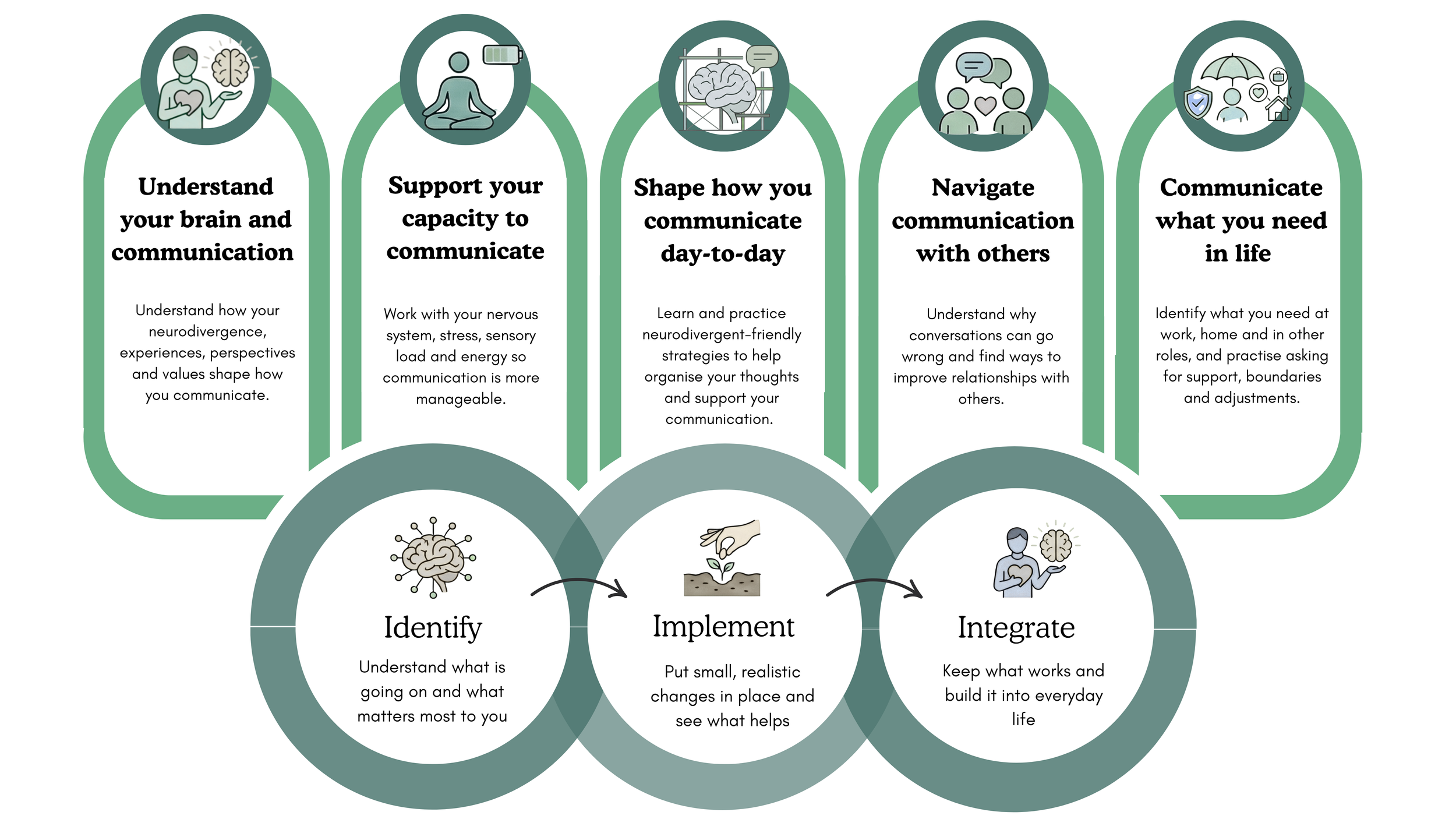
The TalkCoach Five Pillars Framework provides a holistic way of exploring your communication patterns, understanding what helps, and identifying practical changes that feel realistic and sustainable.
Our work may involve exploring your communication from different angles:
Understanding yourself: how your neurodivergence, experiences, perspectives and values shape your communication
Supporting your capacity to communicate: working with your nervous system, stress responses, sensory load and energy, so communication is more manageable
Shaping how you communicate day-to-day: learning and practising neurodivergent-friendly strategies to help support your communication
Navigating communication with others: understanding why conversations can go wrong, why conflict can occur and finding ways to improve relationships with others
Communicating what you need in life: identifying what you need at work, home and in other life contexts, and practising asking for support, boundaries and adjustments by developing self-advocacy skills.
Our Five Pillars Framework also reflects the way we often work: identifying what is going on and what matters most, implementing realistic changes, and integrating what works into everyday life.
Making sessions accessible and person-centred
We know that sessions themselves need to feel manageable.
We will work with you to explore how to make sessions accessible. This may include a clear structure, processing time, direct communication, visual supports or adapting the pace of sessions.
For some people, especially those with Pathological Demand Avoidance (PDA) or demand avoidant profiles, a more directive approach can feel overwhelming and be counterproductive. We aim to work collaboratively and respectfully, without pushing goals that do not feel meaningful or manageable to the person themselves.
This does not mean there is no structure. It means the structure needs to feel supportive and collaborative, rather than pressured or imposed by the therapist.
Awareness first, then strategies that fit
Many people come to us wanting strategies, and strategies can be very helpful.
But strategies usually work best when they are built on awareness.
We look at how communication may be affected by things like executive functioning, processing, sensory load, stress, anxiety, masking and emotional regulation.
In everyday language, this means we are interested in questions like:
Is it hard to organise thoughts quickly in the moment?
Is it difficult to work out which details matter most?
Does spoken information take longer to process?
Does background noise, sensory input or tiredness make communication harder?
Does anxiety or pressure make it harder to access words?
Is masking taking up so much energy that communication becomes exhausting?
When we understand these patterns, it’s easier to identify what helps - and strategies can be developed that are highly personalised and useful.
Rather than giving generic communication tips, we can explore supports that actually reduce communication load and work with the person’s brain, strengths and real-life context.

Speech and Language Therapy and Communication Coaching for neurodivergent clients at TalkCoach
Our Speech and Language Therapists support neurodivergent clients with communication differences and associated communication challenges.
This may include support around language processing, word-finding, verbal organisation, functional communication, social communication, or co-occurring communication challenges such as fluency changes, situational or selective mutism, or functional neurological disorder.
Our Speech and Language Therapists and Communication Coaches can also support areas such as communication confidence, anxiety, masking, expressing boundaries, self-advocacy, workplace communication, relationship patterns and values-aligned communication change.
We will signpost you to the best suited team member based on your specific communication challenges and your availability.
Communication does not happen in isolation
Communication is not just about the individual person.
Communication is affected by the environment, the other people involved, the pace of the interaction, the level of pressure, emotional safety, sensory demands and how much processing time is available.
This means we do not place all responsibility on the neurodivergent person to keep adapting endlessly.
Sometimes support may involve changing how you approach communication.
Sometimes it may involve asking other people to adapt too.
Sometimes it may involve changing the environment, reducing communication load or making expectations clearer.
We can involve other people, such as family members, in your sessions if this is helpful.
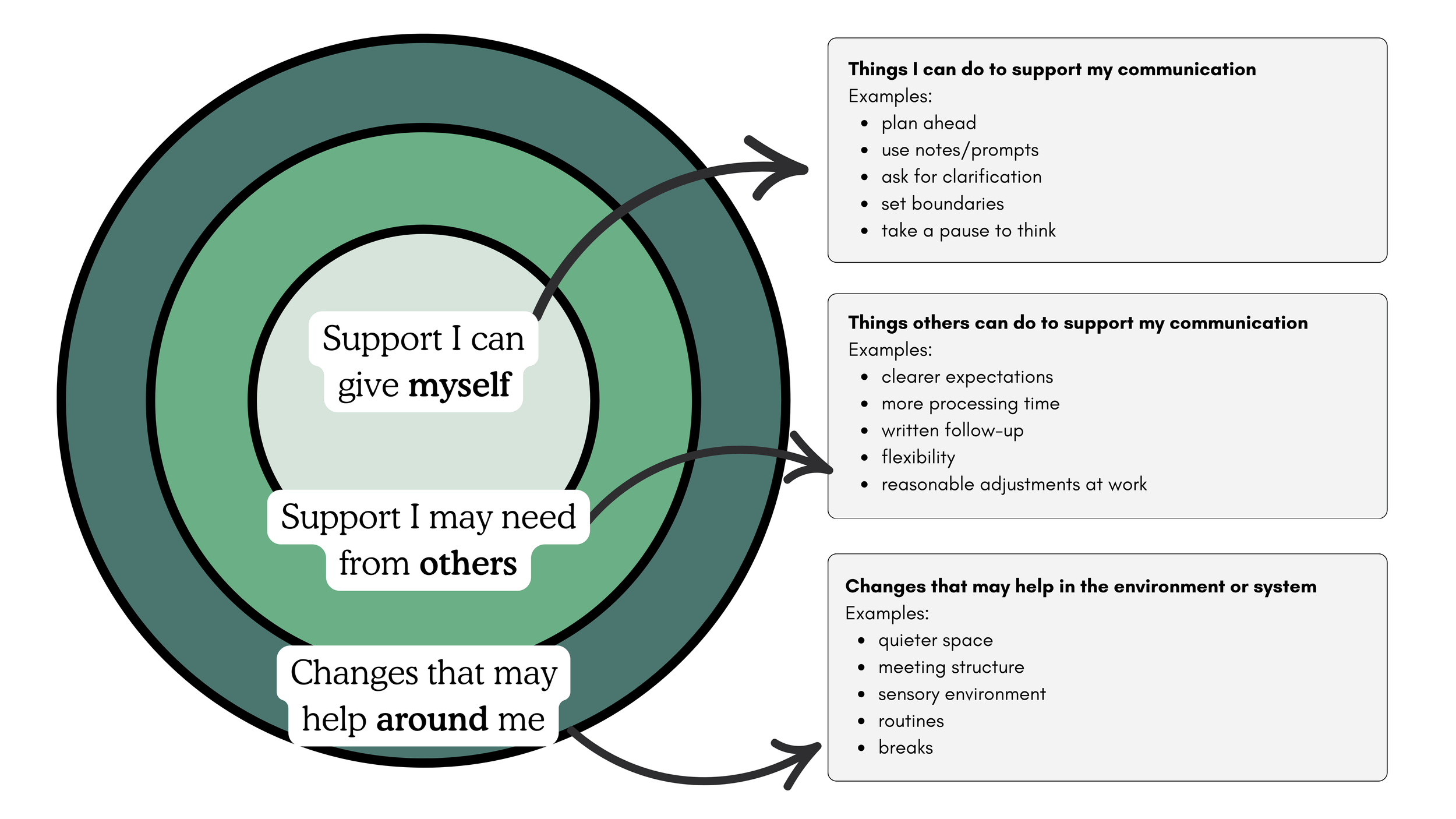
Communication support is not only about changing the individual. At TalkCoach, we explore strategies the person can use, support others can offer, and environmental changes that may make communication easier.
Do you need an ADHD or autism diagnosis to work with us?
No.
Some clients have a formal diagnosis of autism, ADHD or another neurodivergent profile. Some are exploring this. Others simply relate to the communication experiences described here.
You do not need a diagnosis for us to work in a neurodiversity-affirming, person-centred way.
We focus on understanding your communication experiences and helping you find support that feels useful, respectful and practical.
Support for autistic, ADHD and neurodivergent teenagers and young adults
Some parents contact us because their teenager or young adult is struggling with communication confidence, social anxiety, situational or selective mutism, social situations, conversations, education or early work experiences.
We understand that parents are often coming from a place of care, worry and wanting life to feel easier for their child.
Our approach is collaborative and centred around the young person.
We focus on reducing shame, building understanding and supporting communication in a way that feels safe, respectful and sustainable.
We do not work from the goal of making young people “act normal”. We also do not ignore the real-life impact of communication difficulties.
Where appropriate, we may explore confidence, anxiety, conversation skills, communication strategies, emotional safety, sensory needs, executive functioning, self-advocacy and the environments around the young person.

Is TalkCoach the right fit for you?
Different approaches suit different people.
TalkCoach is likely to be a good fit if you are looking for communication support that is practical, reflective, neurodiversity-affirming and person-centred.
We probably aren’t the best fit if you are mainly looking for highly structured social skills training, behaviour-focused intervention, or coaching centred on appearing more polished, confident or ‘neurotypical’ in social situations.
We are also not providing ADHD or autism diagnosis, crisis support or trauma therapy.
What we do offer is collaborative support that aims to reduce unnecessary struggle, while helping you communicate in ways that feel more effective, authentic and aligned with your life.
Most members of our team also bring personal experience of neurodivergence, whether through their own lived experience or through close family members and children, alongside professional training, experience and expertise. This shapes the way we work: with respect, curiosity and compassion.
Ready to Work With Us?
Download our Services and Pricing Guide for more information, including prices and how to book a session.
Once you have reviewed our prices and T+Cs, complete our referral form to get started.








Feeling overwhelmed or near burnout as an independent Speech and Language Therapist running your own private practice?
Striking a balance between running a business and delivering patient care alongside maintaining a life outside of work can be challenging.
This blog post offers practical insights to manage these pressures, which may be particularly beneficial if you’re new to private practice, considering taking the leap into independent work, or experiencing mounting pressure in your independent practice.